Authentication Is a Foundation, Not a Feature
Every auth mistake is invisible at the moment it's made and expensive the moment it's found. That's why it has to be done right the first time.
Every auth mistake is invisible at the moment it's made and expensive the moment it's found. That's why it has to be done right the first time.
Authentication sits at the bottom of almost every system I've built. It is the one layer every user touches, every request passes, and every security review inspects. And because it lives at the bottom, mistakes in it are the most expensive mistakes a system can make: they're invisible until someone is counting on them, and by then the fix has a blast radius.
The cheapest fix is at design time
The interesting thing about auth is that retrofitting it is dramatically harder than building it in. Changing a system's trust model after it ships means migrating users, replaying sessions, and defending decisions that were made before the stakes were clear.
I built the auth service for a product that was shipping to a few hundred beta users. The temptation was to "keep it simple and fix it later." The decision that saved us was choosing the token model up front: short-lived access tokens with hashed, revocable refresh tokens, even though the first version didn't strictly need it. When the beta grew to thousands of users and a security review arrived, nothing had to change. The design had absorbed the growth without a migration.
This is why I treat auth as a design constraint from the first commit, not a feature to bolt on later. The choices that matter (who owns identity, what the session lifetime is, what a "password reset" means, how scopes and roles are represented) are architecture decisions. They shape every feature that comes after.
Do the boring things correctly
Auth security is mostly a list of boring, mandatory details. They aren't clever, they don't demo well, and skipping any of them is a class of bug that shows up in an incident postmortem a year later:
- Hash passwords with a slow, salted algorithm: never invent a scheme, never store reversibly.
- Use standard, maintained libraries: rolling your own crypto is how systems get broken in blog posts.
- Treat tokens as secrets: short-lived, bound to a client, revocable.
- Rate-limit and lock out intelligently: the login form is the front door; leave a light on and a camera running.
- Log, but log carefully: enough to investigate, never enough to leak.
None of these are exciting. All of them are load-bearing.
Sessions end. Accounts persist.
A useful mental model separates authentication from authorization, and both from identity. Authentication is "who are you?" Authorization is "what may you do?" Identity is "who is this person, durably?"
Systems that blur these get into trouble. A session token is used as proof of identity, or a role is stored in a cookie the client can edit, or "admin" becomes a boolean instead of a policy. Each blur is a bug waiting for a motivated user.
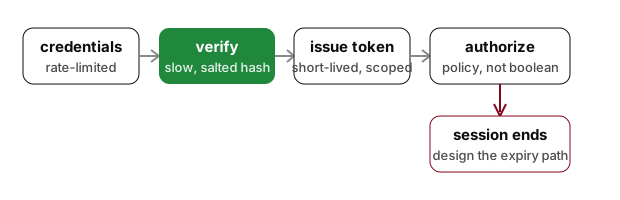
I keep the model explicit, even in small systems. Who you are, what you can do, and how long that lasts should be three different questions with three different answers.
Failure is a feature: design it
The most underrated part of auth is its failure modes. What happens when the session expires mid-checkout? When a user forgets their password? When a token is leaked? These flows are where users feel the system's trustworthiness, and where attackers probe it.
Designing failure modes well means treating the forgotten-password path with the same care as the login path. It means a logout that actually invalidates the session server-side. It means never revealing in error messages whether an email is registered. The smooth paths are where you're measured; the failure paths are where you're attacked.
In the auth service, the most reviewed file is not the login handler. It's the token refresh path: the one that runs on every expired session, handles the race between two devices, and decides when a refresh token must be rotated. Every interesting failure lives there, and designing it deliberately is what makes the happy path feel effortless.
Auth is infrastructure with a human face
Every time a user logs in, they are making a small act of trust: they are handing the system a credential and expecting it to be guarded. The system earns that trust twice: once by doing the boring security correctly, and once by making the experience calm enough that users aren't afraid to use it.
That dual obligation is why I like working on auth systems. They sit exactly where engineering discipline meets human trust. Get the discipline right, and the trust follows.
Takeaway
Treat authentication as a foundation, decided early and built carefully. Do the boring things correctly (hash, tokens, rate limiting, logging), and keep identity, authentication, and authorization distinct. Design the failure paths with the same care as the success paths. Foundations aren't glamorous; they're why the building stands.